
Porn-Induced ED and the Coolidge Effect
Why a generation of healthy young men can't perform with a real partner—the Coolidge effect, supernormal novelty, and how the brain conditions arousal to a screen instead of a human being.

$NOFAP Research
The Symptom No Generation Before Us Had
For most of medical history, erectile dysfunction was a disease of age and arteries—a problem of men in their fifties and sixties with high blood pressure, diabetes, or clogged vessels. Then something changed. Clinicians began reporting a sharp rise in erectile dysfunction, delayed ejaculation, and collapsed libido in healthy men under 40—men with no cardiovascular disease, no organic pathology, nothing physically wrong with the equipment at all.
The review that named the phenomenon, Is Internet Pornography Causing Sexual Dysfunctions? (Park et al., Behavioral Sciences, 2016), traced this collapse to a variable the previous generation never had: unlimited, high-speed, infinitely novel internet pornography. The body works. The wiring has been retrained.
The Coolidge Effect: Your Oldest Circuit
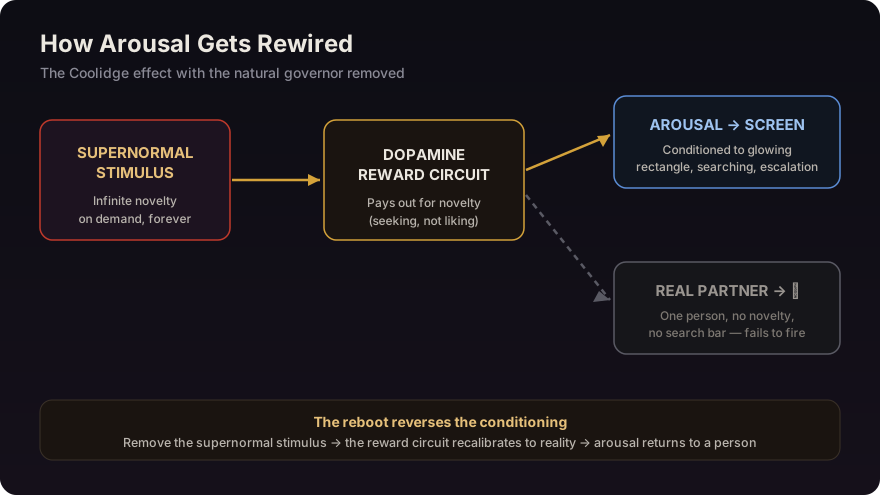
To understand porn-induced ED, you have to understand the Coolidge effect—one of the most robust findings in behavioral biology. Place a male rodent with a receptive female and he mates enthusiastically. Leave them together and his interest plummets to near zero, even though she is still available. He is satiated. But introduce a new female, and he is instantly, fully re-aroused. Swap in a third, a fourth, a fifth—each novel partner resets his drive to maximum.
This is not a quirk of rats. The Coolidge effect appears across virtually every mammal tested, and it is driven by dopamine in the reward circuit responding to sexual novelty. Evolution built it for one reason: to spread genes as widely as possible. Novelty equals reproductive opportunity, so the brain pays out dopamine for novelty.
For the entire history of our species, this circuit had a natural governor: novelty was scarce. A man might meet a handful of potential partners in a lifetime.
Then the tube site arrived—and removed the governor entirely.
The Supernormal Stimulus
A single browsing session delivers more novel "partners" than an ancestral male would have encountered in a thousand lifetimes. This is what biologists call a supernormal stimulus: an artificial trigger that exceeds anything found in nature and hijacks an instinct calibrated for a vanished world.
Internet pornography is the supernormal stimulus engineered to perfection:
- Limitless novelty — a new "partner" every few seconds, on demand, forever.
- Effortless escalation — when one genre stops delivering the dopamine hit, the next tab is one click away. Tolerance pushes users toward more extreme, more shocking, or more specific material to reach the same arousal they used to get easily.
- A format the brain treats as real — video, first-person framing, and endless searching keep the seeking system (dopamine's true domain) maximally engaged.
The Kinsey Institute was among the first to document the consequence, back in 2007: in a lab setting, roughly half of subjects with heavy pornography exposure could not achieve an erection to standard video pornography, and reported needing more extreme or specialized material to respond at all. The researchers had to redesign the study around it.
Wiring Arousal to the Wrong Thing
Here is the mechanism, stripped of mysticism. Sexual arousal is a conditioned response—it gets attached, through repetition and dopamine reinforcement, to whatever reliably precedes orgasm. For the porn user, that "whatever" is not a human being. It is:
- A screen and a glowing rectangle
- The act of searching, clicking, and tab-switching
- Constant visual novelty and the ability to instantly change the channel
- A specific camera angle, genre, or intensity that escalated over years
A real partner offers none of this. One person. One body. No search bar. No escalation. No fast-forward. To a nervous system trained on the supernormal version, the real thing does not register as meeting expectations—and arousal simply fails to fire. The man is not broken. His arousal template has been overwritten.
An Honest Look at the Science
Intellectual honesty is part of the discipline, so the debate must be stated plainly. Porn-induced ED is not yet settled science. Some large studies muddy the picture:
- A multivariate study of 3,586 men (Rowland et al., International Journal of Impotence Research, 2022) found that raw frequency of pornography use was not a reliable predictor of erectile dysfunction once age, anxiety, depression, and relationship factors were controlled.
- Yet other work points the other way: Whelan & Brown (Journal of Sexual Medicine, 2021) found that self-perceived addiction to pornography did predict erectile dysfunction, premature ejaculation, and dissatisfaction—even when frequency alone did not.
The honest synthesis: it may not be how often you use, but whether use has become compulsive, escalating, and the dominant sexual outlet. The mechanism—conditioning arousal to a supernormal stimulus the real world can't match—is biologically coherent and supported by clinical reports, even where population statistics remain noisy.
And one finding is hard to argue with: when men with these symptoms quit, function returns. Clinical reports repeatedly show that removing internet pornography is sometimes sufficient, by itself, to reverse the dysfunction. That is the closest thing to a controlled experiment we have—and it points one direction.
The Reboot Is the Test
If arousal was trained onto the screen, it can be retrained onto reality. Abstaining from the supernormal stimulus forces the reward circuit to recalibrate to natural levels of stimulation—a process the recovery community calls the reboot (covered in depth in What Happens When You Quit Porn - The 90-Day Reboot). Men who complete it consistently report the return of spontaneous erections, morning wood, genuine attraction to real partners, and arousal that responds to a person instead of a feed.
The Coolidge effect was never your enemy. It is a healthy, ancient circuit. The pornography industry simply found the cheat code—and the only counter-move is to stop feeding it the cheat.
You are not chasing novelty. You are reclaiming the capacity to be aroused by something real.
Sources and Further Reading
- Park, B.Y., Wilson, G., Berger, J., et al. (2016). Is Internet Pornography Causing Sexual Dysfunctions? A Review with Clinical Reports. Behavioral Sciences, 6(3), 17.
- Jordan, K. & Brooks, R. (2010). The Coolidge effect and its relevance to human sexual behaviour. (Behavioral biology literature on novelty-driven re-arousal.)
- Rowland, D.L., et al. (2022). Do pornography use and masturbation play a role in erectile dysfunction and relationship satisfaction in men? International Journal of Impotence Research.
- Whelan, G. & Brown, J. (2021). Pornography Addiction: Perceived Addiction, Erectile Dysfunction, Premature Ejaculation, and Sexual Satisfaction in Males Aged 18–44. Journal of Sexual Medicine, 18, 1582–1591.
- Kühn, S. & Gallinat, J. (2014). Brain Structure and Functional Connectivity Associated With Pornography Consumption. JAMA Psychiatry, 71(7), 827–834.
- "The Great Porn Experiment V2.0" (2022). Archives of Sexual Behavior — experimental test of Coolidge-like effects of pornographic exposure on attraction.
Monk Mode - The 90-Day Discipline Protocol
Willpower is not the answer—it's why you keep failing. The actual mechanics of breaking the loop — rewiring cues, replacing the routine, surfing the urge, and engineering an environment where relapse is hard and discipline is default.
The Pornography Industrial Complex
Who actually profits from your addiction—the Montreal company that drew more monthly traffic than Google and Facebook combined, the data they harvest, and how a federal regulator called them 'morally bankrupt.'