
Monk Mode - The 90-Day Discipline Protocol
Willpower is not the answer—it's why you keep failing. The actual mechanics of breaking the loop — rewiring cues, replacing the routine, surfing the urge, and engineering an environment where relapse is hard and discipline is default.

$NOFAP Protocol
Willpower Is Why You Keep Losing
Every relapse follows the same autopsy: "I just need more willpower." It is the wrong diagnosis, and it guarantees the next failure. Behavioral science is brutally clear on this—willpower is a finite, depletable resource, and trying to win on willpower alone is fighting the strongest drive in your nervous system with your weakest tool.
Compulsive behavior is not a character flaw. It is a habit loop—a piece of automated neural machinery. And machinery is not defeated by motivation. It is defeated by engineering. Monk Mode is that engineering: a 90-day protocol built on how the brain actually forms and breaks habits, mapped onto the recovery timeline from What Happens When You Quit Porn - The 90-Day Reboot.
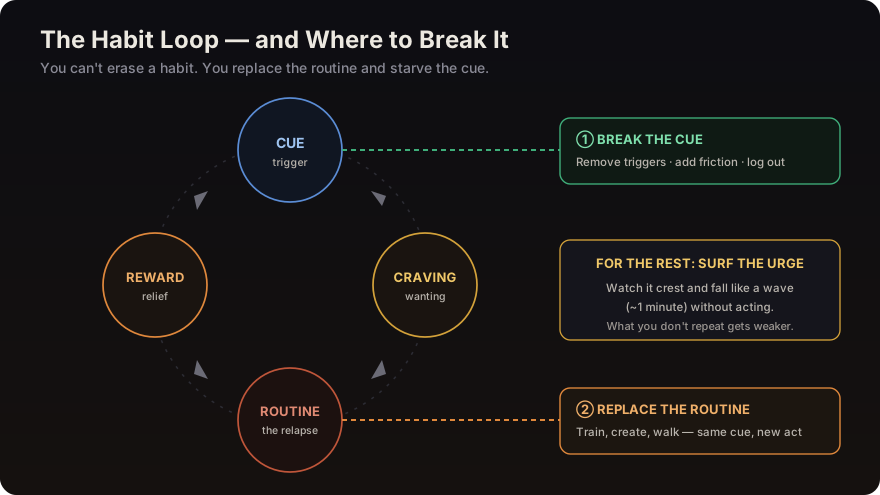
Know Your Enemy: The Habit Loop
Charles Duhigg and James Clear popularized the model neuroscience confirms. Every habit runs in four stages:
- Cue — a trigger (a time, place, emotion, or preceding action) that tells the brain to run a stored routine. You don't decide to crave. The cue decides for you.
- Craving — the anticipatory pull, the dopamine spike of wanting, that fires the instant the cue appears.
- Routine — the behavior itself (the relapse).
- Reward — the relief/escape/numbness that teaches the brain to carve the loop deeper.
Here is the law that changes everything—the Golden Rule of habit change: you cannot erase a habit. You can only replace the routine while keeping the cue and delivering the reward another way.
This is exactly why willpower fails. White-knuckling blocks the middle of the loop while leaving the cue and the craving fully intact. The pressure doesn't disappear—it builds, until it finds a way through, either as relapse or as cross-addiction (you quit porn and start binge-eating, doomscrolling, or drinking). You didn't fix the loop. You just dammed it without a channel.
The Protocol
Phase 1 — Clear the Field (Days 1–14)
The first two weeks overlap with acute withdrawal—cravings loud, willpower still relatively full. Spend that fuel on structural changes you only have to make once, not on minute-to-minute resistance.
- Remove the cues. Porn lives behind triggers: the phone in bed, the laptop in a locked room, late-night solitude, specific apps. Engineer them out. Phone charges in the kitchen overnight. Install content blockers and hand the password to someone else. No screens in bed.
- Add friction. Clear made it a law: to break a bad habit, make it difficult. Log out of everything. Delete the apps. Put 20 seconds of obstacle between cue and routine—20 seconds is often enough for the prefrontal cortex to catch up.
- Announce the streak. Accountability (a partner, a community, a tracker) converts a private failure into a visible one, raising the cost of relapse.
Phase 2 — Replace the Routine (Weeks 2–8, through the flatline)
You cannot run a vacuum. The cue will still fire; the craving will still come. You need a pre-decided replacement routine that delivers a real reward, ready before you need it.
- When the urge hits, you do not "resist"—you execute the substitute: drop and do pushups, walk outside, cold shower, lift, call someone, open the project you're building.
- This is also where transmutation lives (see The Law of Sex Transmutation): the charged energy is fuel. Pour it into training or creation the moment it arrives.
- Expect the flatline here—flat mood, no libido, low drive. This is repair, not failure. Do not "test" yourself by peeking. The protocol is what carries you when motivation is gone.
Phase 3 — Surf the Unpredictable Urges (ongoing)
You can engineer away your known cues. You cannot anticipate all of them—a random image, a stray memory, a wave of boredom. For those, you need a general-purpose tool: urge surfing, developed by addiction researcher Alan Marlatt.
The technique is mindfulness, not suppression. When the urge rises:
- Stop and notice it instead of fighting or feeding it.
- Locate the physical sensation—where it sits in the body, its intensity, its edges.
- Watch it like a wave. Urges crest and fall; they do not climb forever. Breathe through it for five breaths—about a minute.
- Stay curious, not afraid. Replace "make it stop" with "let me watch this pass."
The principle, in Marlatt's framing: what you repeat gets stronger; what you don't repeat gets weaker. Every urge you surf instead of obey weakens the loop. Every relapse strengthens it. You are literally rewiring which response the cue triggers.
Phase 4 — Build Mastery and Identity (Months 2–3+)
By now the receptors are recovering and natural rewards are coming back online. Convert the negative ("I'm quitting porn") into a positive identity ("I am a disciplined man who trains, builds, and retains"). Stack new habits onto existing anchors ("after my morning coffee, I train"). Use time- and location-based cues to make the good routines as automatic as the bad ones used to be. The goal is a life where discipline isn't effortful—it's default.
The Rules That Make It Work
- One urge at a time. Self-regulation is finite; don't try to overhaul your entire life in week one. Win the next urge.
- Reduce vulnerability. Marlatt's research and basic physiology agree: poor sleep, no exercise, bad food, and isolation deplete the very reserves you need. Guard them. A tired, lonely, sedentary man relapses.
- Willpower is a muscle. It depletes in the moment but strengthens with use over time. Every rep of self-regulation makes the next one easier.
- Praise the attempt, not just the win. Even a surfed urge that was close is a rep. Encouragement sustains motivation; shame destroys it.
The Reframe
You are not a weak man trying to be strong. You are an engineer dismantling a machine that was built—by the porn industry and the attention economy—to run automatically inside your skull. You don't out-muscle a machine. You rewire it: pull its cues, starve its rewards, and install a better loop in its place.
Ninety days is not an arbitrary number. It's roughly how long the brain needs to lay down new pathways and recover its reward system. Engineer the environment, run the protocol, surf the waves, and let the machinery of habit—the same force that enslaved you—start working for you instead.
Sources and Further Reading
- Clear, J. (2018). Atomic Habits — the cue–craving–response–reward loop and the four laws of behavior change.
- Duhigg, C. (2012). The Power of Habit — the Golden Rule of habit change.
- Marlatt, G.A. & Gordon, J.R. (1985). Relapse Prevention — the origin of urge surfing.
- Sepah, C. — "Dopamine Fasting 2.0," a CBT-based stimulus-control protocol.
- Bowen, S. & Marlatt, A. (2009). Surfing the urge: brief mindfulness-based intervention for college student smokers. Psychology of Addictive Behaviors.
MK-ULTRA and the Weaponization of Sexuality
From CIA mind control laboratories to the pornography industry—how trauma-based programming turned human sexuality into a weapon of mass destruction.
Porn-Induced ED and the Coolidge Effect
Why a generation of healthy young men can't perform with a real partner—the Coolidge effect, supernormal novelty, and how the brain conditions arousal to a screen instead of a human being.