
Kundalini and Energy Transmutation
Understanding the serpent power, the physio-kundalini model, and how conservation of vital essence catalyzes higher consciousness.

$NOFAP Spirituality
The Latent Power
The human organism is a multi-layered vehicle of consciousness, interpenetrated by subtle energy systems that modern science is only beginning to map. At the foundation of these systems lies kundalini—a potent bio-spiritual energy described in the yogic tradition as a coiled serpent sleeping at the base of the spine. When dormant, it maintains ordinary consciousness. When awakened, it produces transformations that transcend normal psychological and physiological limits.
This is not merely esoteric symbolism. Clinical psychiatrist Lee Sannella, M.D., documented in Kundalini: Psychosis or Transcendence? (1976) that this process has observable physiological correlates across diverse cultures and traditions. Working with physicist Itzhak Bentov, Sannella developed the physio-kundalini model—a framework describing the awakening as an evolutionary neuro-physiological process rather than supernatural phenomenon.
The Energy Architecture
The Central Channel (Sushumna) runs parallel to the spinal cord, serving as the primary conduit for kundalini's ascent. On either side flow:
- Ida (lunar, cooling, mental energy)
- Pingala (solar, heating, vital energy)
Kundalini represents a third force that transcends this duality. When awakened, it enters the central channel and begins its upward journey, producing unified awareness that integrates previously segregated functions of consciousness.
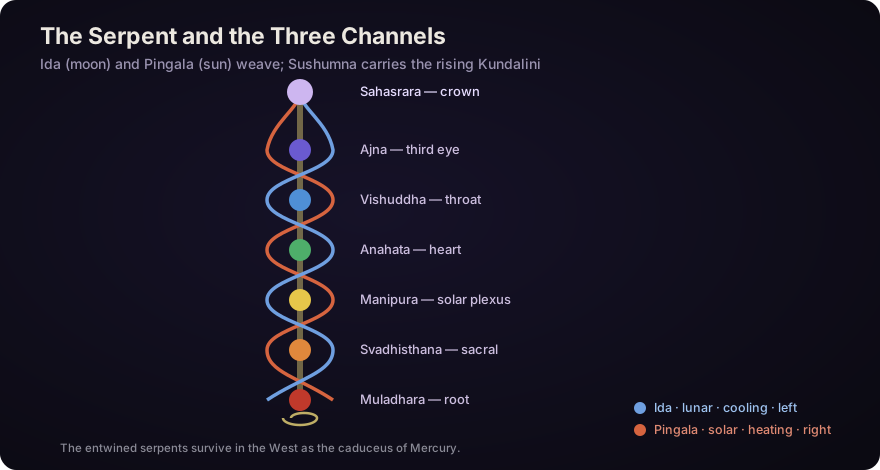
Swami Sivananda details the polarity precisely in Kundalini Yoga: Ida flows through the left nostril and is Chandra Nadi (the moon)—cooling, nourishing, governing the mental processes; Pingala flows through the right nostril and is Surya Nadi (the sun)—heating, digesting, governing the vital processes. The two weave back and forth around the spine and cross at the base of the skull—the very image preserved in the West as the caduceus of Mercury, the two serpents entwined around the central staff. As one classical source notes, "Kundalini does not begin its activity through the Sushumna until the Ida (negative) and Pingala (positive) have preceded it"—balancing the solar and lunar currents is the precondition for the serpent's ascent. George Kavassilas adds the traditional image: the serpent lies "coiled three and a half times," the three coils representing the three gunas and the half-coil signifying transcendence.
The Chakra System: A Graduated Awakening
As kundalini rises through the subtle body, it activates and purifies successive energy centers:
Root (Muladhara)
Transformation: From fear and survival anxiety to grounded security and trust. The energetic foundation shifts from contraction to openness.
Sacral (Svadhisthana)
Transformation: Sexual drive becomes creative force. The energy previously directed toward reproduction and pleasure becomes available for artistic, intellectual, and spiritual creation.
Solar Plexus (Manipura)
Transformation: Ignition of willpower and personal authority. The practitioner develops the capacity for sustained discipline and directed intention.
Heart (Anahata)
Transformation: Dissolution of rigid ego boundaries. Compassion becomes spontaneous rather than effortful; the sense of separation between self and others begins to dissolve.
Throat (Vishuddha)
Transformation: Authentic expression emerges. The practitioner speaks from direct experience rather than social conditioning.
Third Eye (Ajna)
Transformation: Inner vision awakens. Intuition, insight, and non-conceptual knowing become accessible.
Crown (Sahasrara)
Transformation: Union with universal consciousness. The individual wave recognizes itself as the ocean.
Cross-Cultural Validation
The kundalini phenomenon is not exclusive to Hindu yoga. Anthropological and clinical research reveals striking parallels:
The !Kung San of the Kalahari describe "n/um"—a heating energy residing in the pit of the stomach that rises during trance dances. As anthropologist Richard Katz documented, "You dance, dance, dance. Then n/um lifts you in your belly and lifts you in your back... n/um enters every part of your body, right to the tip of your feet and even your hair."
Taoist China describes the same progression: after achieving stillness of mind, "the vital principle, prana, bursts out and begins to flow in the main psychic channels of the body causing involuntary movements." The eight physical sensations produced—pain, itching, coldness, warmth, weightlessness, heaviness, roughness, and smoothness—correspond precisely to yogic descriptions.
Christian Mysticism: St. Teresa of Avila described "spiritual marriage" accompanied by intense heat, involuntary movements, and ecstatic states. The 20th-century mystic St. Therese of Lisieux experienced precisely the motor and sensory symptoms catalogued in kundalini literature.
Korean Zen teaches that chi energy travels up the body, over the top of the head, down the face, and through the throat to terminate in the abdomen—the exact path described by Bentov's physiological model.
The Bentov Model: A Physiological Framework
Physicist Itzhak Bentov proposed that kundalini awakening represents a self-regulating mechanism of the central nervous system. In his model:
- The body's natural rhythmic vibrations (micro-motions) become synchronized
- This coherent oscillation creates standing waves within the cerebral ventricles
- The resulting pressure waves travel through the cerebrospinal fluid
- These waves stimulate successive regions of the brain and nervous system
The "serpent power" is thus reinterpreted as coherent bioelectrical activity that progressively reorganizes neural function. The heat, light, and involuntary movements are understood as measurable physiological phenomena rather than metaphysical abstractions.
The Role of Semen Retention
The sexual fluid contains the physical correlate of kundalini energy—the Jing essence (Taoist) or Ojas (Hindu) that fuels the entire ascent. Every ejaculation depletes this fuel reserve. The retainer:
- Conserves the substrate: Maintains the chemical and energetic foundation for kundalini activation
- Builds the vessel: Strengthens the nervous system and subtle energy channels to handle increased energetic flow
- Cultivates awareness: Develops the meditative capacity to direct and integrate the awakening force
As the Hatha Yoga Pradipika states: "Just as a door is opened with a key, similarly the yogi opens the door to liberation with kundalini." But the key requires the energy of retention to turn.
Integration and Caution
Kundalini awakening is not without risks. Premature or unmanaged activation can produce what Western psychiatry might misdiagnose as psychosis. The symptoms—involuntary movements, sensory disturbances, emotional volatility, and altered states of consciousness—are identical to certain pathological conditions.
However, as Sannella's clinical work demonstrated, these same symptoms, when understood and supported within an appropriate framework, lead to "deep psychological balance, strength, and maturity." The difference lies in context, preparation, and guidance.
Paramhansa Yogananda cut through the fear-mongering on both sides: "To waken the kundalini is essential for spiritual aspirants... It is important, on the other hand, to understand that kundalini awakening should be natural, never forced." Retention supplies the fuel; patience and grounding supply the safety.
The path requires both energy (through retention and practice) and container (through grounding, lifestyle, and wisdom). Neither alone is sufficient.
Sources and Further Reading
- Sannella, L. (1976). Kundalini: Psychosis or Transcendence?.
- Bentov, I. (1977). Stalking the Wild Pendulum.
- Krishna, G. (1971). Kundalini: The Evolutionary Energy in Man.
- Satyananda Saraswati, S. (1984). Kundalini Tantra.
- Katz, R. (1976). Boiling Energy: Community Healing among the Kalahari Kung.
- Luk, C. (1972). The Secrets of Chinese Meditation.
- Sivananda, S. Kundalini Yoga (Ida/Pingala/Sushumna, the chakras, and the practice).
- Yogananda, P. Revelations of Christ (on natural vs. forced kundalini awakening).
- Kavassilas, G. Our Universal Journey (the three-and-a-half coils and the gunas).
- Sadhguru. "Kundalini Yoga: Awakening the Shakti Within." YouTube (Isha Foundation).
The Attention Economy - Social Media as Digital Gooning
The men who built the feed admit it on the record—it was designed as a slot machine to exploit "a vulnerability in human psychology." Porn and the infinite scroll run on the exact same dopamine hijack.
The Microcosmic Orbit - Taoist Inner Alchemy
The 2,000-year-old technique for circulating retained sexual energy up the spine and through the body instead of leaking it out. A practical guide to the Taoist orbit that turns Jing into Qi into Shen.