
The Attention Economy - Social Media as Digital Gooning
The men who built the feed admit it on the record—it was designed as a slot machine to exploit "a vulnerability in human psychology." Porn and the infinite scroll run on the exact same dopamine hijack.

$NOFAP Intelligence
They Told You Themselves
You don't have to take this from a "cult." Take it from the men who built the machine.
Sean Parker, Facebook's founding president, on the record in 2017:
"The thought process that went into building these applications... was all about: How do we consume as much of your time and conscious attention as possible? And that means we need to sort of give you a little dopamine hit every once in a while... It's a social-validation feedback loop... exactly the kind of thing that a hacker like myself would come up with, because you're exploiting a vulnerability in human psychology. The inventors, creators—it's me, it's Mark, it's Kevin Systrom on Instagram—understood this consciously. And we did it anyway."
That is not a conspiracy theory. That is a confession. The feed was engineered, deliberately, by people who knew exactly what they were doing to your brain—and shipped it anyway.
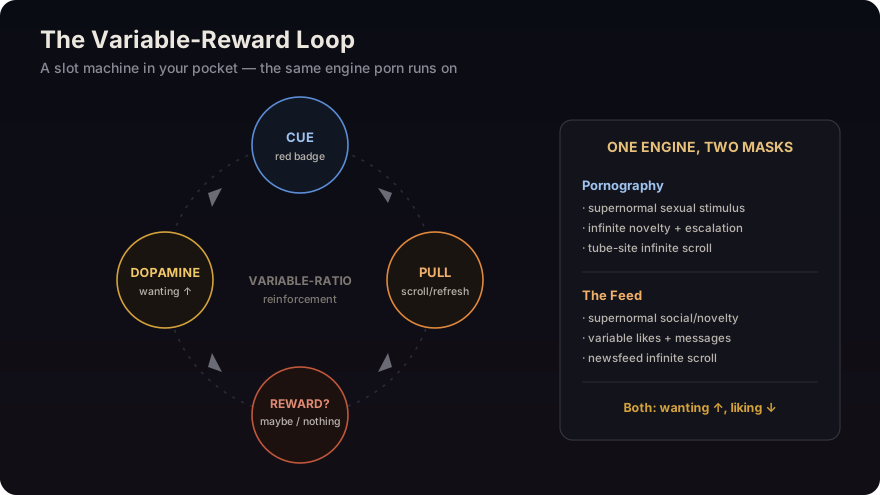
The Slot Machine in Your Pocket
Tristan Harris, a former Google design ethicist who became the industry's most prominent defector, named the mechanism precisely: "If you're an app, how do you keep people hooked? Turn yourself into a slot machine."
The psychology is a century old and ironclad. Variable-ratio reinforcement—rewards delivered on an unpredictable schedule—is the most powerful conditioning pattern known to behavioral science. It is why slot machines are the most addictive form of gambling, hooking players two to three times faster than other games, and why they out-earn baseball, movies, and theme parks combined in the United States.
Every time you pull down to refresh, every time you open an app to a red notification badge, every time you scroll to "see what's next"—you are pulling a lever. Sometimes you get a reward (a like, a message, a hit of novelty). Sometimes you get nothing. That unpredictability is not a flaw. It is the product. The designer of the pull-to-refresh gesture, Loren Brichter, later admitted he'd built a slot-machine mechanic and questioned whether his work had any "net positive impact on society at all."
The Same Hijack, A Different Feed
Here is the connection the wellness influencers miss: pornography and the infinite scroll are not two problems. They are one problem wearing two masks.
Both exploit the identical circuitry described in The Neuroscience of Porn Addiction:
| Pornography | The Feed | |
|---|---|---|
| Core exploit | Supernormal sexual stimulus | Supernormal social/novelty stimulus |
| Reward pattern | Endless novelty, escalation | Variable-ratio: likes, messages, "what's next" |
| Neurotransmitter | Dopamine (seeking, not liking) | Dopamine (seeking, not liking) |
| Mechanism | Tube-site infinite scroll | Newsfeed infinite scroll |
| The trap | Wanting rises, liking falls | Wanting rises, liking falls |
Both keep you in a permanent state of "wanting" without "liking"—the dopaminergic signature of all addiction, where anticipation is chronically stimulated and satisfaction never arrives. Both desensitize the reward system, so ordinary life goes grey and you need ever-larger doses to feel normal. Gooning to a screen and doomscrolling a feed are the same act, performed on the same neural hardware, for the same corporate purpose. This is why we call it digital gooning.
"The Race to the Bottom of the Brainstem"
Harris described the economic engine that guarantees it gets worse: every app, every site, every platform competes for one finite resource—your attention. And the surest way to win attention is to "go lower into the lizard brain."
"It becomes this race to the bottom of the brainstem, where if I go lower... to get you using my product, I win." — Tristan Harris
Outrage out-performs calm. Novelty out-performs depth. The supernormal out-performs the real. So the algorithms, optimizing relentlessly for engagement, evolve toward whatever most efficiently bypasses your rational mind and pulls the lever in your brainstem. As Harris puts it, "a handful of people working at a handful of tech companies steer the thoughts of billions of people every day." You think you are choosing. You are being steered.
Why This Matters to the Mission
A man cannot retain his seed while leaking his attention into a thousand other slot machines all day. The same prefrontal cortex that resists the urge to relapse is the muscle the feed is designed to fatigue. Every hour of mindless scroll erodes the exact faculty—focus, impulse control, delayed gratification—that the streak depends on. Defeating porn while remaining jacked into the feed is fighting one hand of the same enemy while shaking the other.
The discipline scales. The man who reclaims his sexual energy and then hands his attention to the algorithm has simply changed which machine is harvesting him. The full move is to reclaim attention itself:
- Kill the variable reward: turn off notifications, grayscale the screen, delete the apps from the phone.
- Add friction where they removed it: log out, uninstall, put the device in another room.
- Replace the lever-pull with something real—training, reading, building, people (see Monk Mode).
Their entire empire is built on the bet that you cannot stop pulling the lever. Retaining your seed and reclaiming your attention is the same war. Win it.
Sources and Further Reading
- Solon, O. (2017). "Ex-Facebook president Sean Parker: site made to exploit human 'vulnerability.'" The Guardian.
- Harris, T. (2016). "How Technology is Hijacking Your Mind." Medium; and "How a handful of tech companies control billions of minds every day," TED (2017).
- Skinner, B.F. — foundational research on variable-ratio reinforcement schedules.
- Schüll, N.D. (2012). Addiction by Design: Machine Gambling in Las Vegas. Princeton University Press.
- Cross-reference: The Neuroscience of Porn Addiction (dopamine, wanting vs. liking, desensitization).