
The Neuroscience of Porn Addiction
How high-speed internet pornography hijacks your brain's reward circuitry, alters neural architecture, and why abstinence triggers neurobiological restoration.

$NOFAP Research
The Hijacking of an Ancient System
The human brain evolved over millions of years in an environment of scarce rewards and genuine survival threats. Its reward system—centered on the mesolimbic dopamine pathway—was calibrated to motivate behaviors essential for survival and reproduction. Dopamine, the primary neurotransmitter in this circuit, was never designed to handle the supernormal stimuli that modern technology delivers.
As research published in JAMA Psychiatry (Kühn & Gallinat, 2014) demonstrates, frequent pornography consumption is associated with reduced gray matter volume in the right caudate nucleus—a key structure within the striatum involved in habit formation, reward processing, and motivation. This structural alteration correlates with both the frequency of consumption and the degree of reported compulsivity.
The Dopamine Dysregulation Cascade
Internet pornography represents what neuroscientists call a "supernormal stimulus"—an artificial reward that bypasses all natural checkpoints and delivers unlimited novelty directly to the visual cortex. Where ancestral humans might encounter a handful of potential mates in a lifetime, the modern user confronts thousands of novel sexual stimuli within a single session.
Neuroimaging studies reveal a catastrophic mismatch between this ancient neural machinery and its modern technological environment:
1. Ventral Striatal Dysfunction The ventral striatum—including the nucleus accumbens—shows altered cue-reactivity in problematic users. A 2017 fMRI study published in Neuropsychopharmacology found that men seeking treatment for problematic pornography use (PPU) exhibited increased ventral striatal activation specifically in response to cues predicting erotic rewards, but not in response to the rewards themselves. This dissociation between "wanting" (anticipatory dopamine release) and "liking" (actual reward consumption) mirrors the neural profile observed in substance and gambling addictions.
2. Prefrontal Cortical Atrophy The prefrontal cortex (PFC)—evolution's most sophisticated machinery for executive control, risk assessment, and impulse inhibition—shows measurable structural compromise in heavy users. As addiction researcher Rita Goldstein's neuroimaging studies at Mount Sinai have demonstrated, changes in prefrontal regions affect judgment, self-control, and cognitive functions essential for behavioral regulation. The PFC, which acts as the brain's "supervisory system," becomes progressively weakened, allowing compulsive behaviors to override rational decision-making.
3. The DeltaFosB Molecular Switch At the molecular level, the protein DeltaFosB accumulates in the nucleus accumbens with chronic overstimulation. This transcription factor functions as a persistent molecular switch, sensitizing neural circuits to addiction-related cues while simultaneously desensitizing them to natural rewards. Unlike most proteins that degrade within hours, DeltaFosB can remain elevated for weeks or months, explaining why addictive patterns persist long after cessation and why relapse vulnerability remains elevated during early recovery.
Neuroplastic Changes and Tolerance
Neuroplasticity—the brain's ability to reorganize itself by forming new neural connections—becomes a liability under conditions of chronic overstimulation. As documented in comprehensive reviews of Internet pornography addiction (Behavioral Sciences, 2015; Surgical Neurology International, 2011), repeated dopaminergic surges stimulate neuroplastic changes that reinforce the addictive experience.
These changes manifest as:
- Tolerance: Previously established neural maps for natural sexuality cannot compete with the continuously reinforced maps generated by high-speed streaming content. Users progressively escalate to more explicit material to maintain equivalent levels of arousal.
- Habituation: Unlike natural rewards that exhibit normal satiety responses, the drug-like stimulus of internet pornography appears perpetually novel, commanding attention without attenuation.
- Cue-reactivity: Environmental triggers—smartphone notifications, specific times of day, emotional states—become conditioned stimuli capable of activating the reward circuit independent of conscious awareness.
The Post-Orgasm Hangover
The reward circuit doesn't just escalate—it crashes. The moment of orgasm triggers a neurochemical reversal that the older literature poetically called post-nut clarity and the research describes clinically.
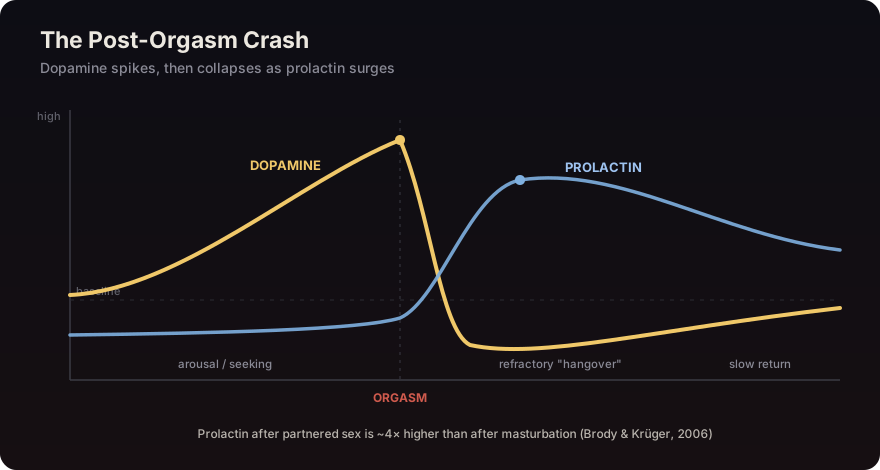
At climax, dopamine drops and prolactin surges—a satiety signal that suppresses dopamine and drives the refractory period. Krüger and colleagues, in a series of studies on the neuroendocrinology of orgasm, documented this prolactin spike and its role in sexual satiation. Strikingly, Brody and Krüger (2006) found that the prolactin rise after partnered intercourse is roughly 400% greater than after masturbation—a measurable biochemical signature that the brain does not treat all orgasms as equal. Receptors for testosterone in the reward circuitry decline in this window, further blunting dopamine release.
The result is the familiar lethargy, deflation, and loss of drive that follows compulsive use—the brain temporarily down-shifted while it claws back toward homeostasis. Repeat the cycle daily, on a supernormal stimulus, and the system never fully recovers between hits. As urologist Rena Malik, M.D. notes in her review of the evidence, the better-supported intervention isn't merely retention—it is removing pornography itself, which "can really affect your brain and the way you perceive sex" and relationships.
The Path of Restoration
Recovery is not merely a psychological achievement but a neurobiological restoration. Abstinence initiates a cascade of healing processes:
- DeltaFosB downregulation begins within days, gradually reducing cue-sensitivity
- Dopamine receptor upregulation restores normal sensitivity to natural rewards
- Prefrontal cortex function improves as neuroplastic changes reverse direction
- Natural reward responsiveness returns as the brain recalibrates its salience attribution
As addiction medicine has established, this is not a moral failing but a neurochemical hijacking that can be reversed through sustained discipline, environmental modification, and time. The brain that was altered by excess can be restored through abstinence.
Sources and Further Reading
- Kühn, S. & Gallinat, J. (2014). Brain Structure and Functional Connectivity Associated With Pornography Consumption. JAMA Psychiatry, 71(7), 827-834.
- Brand, M. et al. (2016). Ventral Striatum Reactivity in Compulsive Sexual Behaviors. Neuropsychopharmacology, 41, S370-S371.
- Love, T. et al. (2015). Neuroscience of Internet Pornography Addiction: A Review and Update. Behavioral Sciences, 5(3), 388-433.
- Volkow, N.D. et al. (2016). Neurobiologic Advances from the Brain Disease Model of Addiction. New England Journal of Medicine, 374(4), 363-371.
- Krüger, T.H.C. et al. (2003). Orgasm-induced prolactin secretion: feedback control of sexual drive? Neuroscience & Biobehavioral Reviews, 26(1), 31–44.
- Brody, S. & Krüger, T.H.C. (2006). The post-orgasmic prolactin increase following intercourse is greater than following masturbation. Biological Psychology, 71(3), 312–315.
- Malik, R., M.D. "Does science support No Nut November?! | A Urologist explains semen retention." YouTube (urologist review of the semen-retention evidence).
The Archontic War - Why They Feed on Your Seed
The Gnostic revelation of energy-harvesting entities, the loosh economy, and how semen retention breaks the Archontic food chain.
The Superpowers - Myth vs. Mechanism
Confidence, energy, magnetism, a deeper voice—the famous NoFap superpowers. We separate the marketing from the mechanism — what the research actually supports, what's exaggerated, and why the real effect is bigger than the myth.