
What Happens When You Quit Porn - The 90-Day Reboot
A stage-by-stage map of what actually happens in the brain when you quit—the withdrawal spike, the dreaded flatline, dopamine receptor recovery, and why most men relapse three weeks before the breakthrough.

$NOFAP Research
Why "Just Stop" Isn't the Whole Story
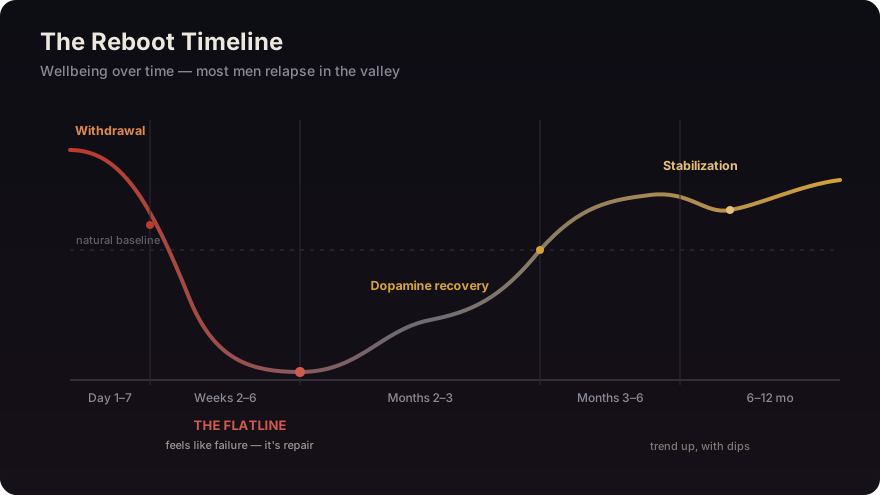
Every man who quits expects a straight line: stop the behavior, feel better, get stronger. The reality is stranger and more brutal. Recovery from compulsive pornography use follows a predictable neurobiological arc—one with a vicious trap built into the middle of it. Most men who fail don't fail at the start, when willpower is high and motivation is fresh. They fail in weeks two through six, in a valley called the flatline, three weeks before the brain was about to reward them.
If you know the map, you don't panic in the valley. This is the map.
What Got Broken: The Setup
To understand recovery, understand the damage. Chronic overstimulation floods the reward center (the nucleus accumbens) with dopamine far beyond what natural rewards produce. The brain, defending its equilibrium, fights back two ways:
- It accumulates ΔFosB — a transcription factor that acts as a long-lasting molecular "switch," sensitizing the brain to the addictive cue while dulling everything else.
- It downregulates D2 dopamine receptors — it literally prunes away receptors so the same flood produces less signal. This is desensitization, and it is why nothing feels good anymore: not food, not exercise, not conversation, not real intimacy. The baseline has been raised so high that ordinary life reads as grey.
Recovery is the slow reversal of both. And reversal has a shape.
Stage 1 — Acute Withdrawal (Days 1–7+)
When you remove the supernormal stimulus, the brain protests loudly. With dopamine inputs gone but receptors still downregulated, the nervous system swings into withdrawal:
- Intense, intrusive cravings and "just once" bargaining
- Irritability, restlessness, anxiety
- Insomnia or disrupted sleep
- Difficulty concentrating
Neurochemically this tracks a drop in dopamine and opioids, a rise in stress hormones (CRF and norepinephrine), and elevated dynorphin, which actively suppresses the pleasure response. This is the same withdrawal architecture documented across behavioral addictions. It is uncomfortable, it is normal, and it is temporary. The cravings here are loud but the willpower tank is usually full. Most men survive this stage.
Stage 2 — The Flatline (Weeks 2–6)
Then the cravings quiet down—and something worse arrives. The flatline is a stretch of emotional and sexual numbness: low or absent libido, flat mood, brain fog, fatigue, and a disturbing sense that nothing matters. Some men experience a complete loss of sexual desire and panic that they've "broken" themselves permanently.
This is the single most dangerous point in the entire process, for one reason: it feels exactly like failure. Men interpret the numbness as depression getting worse, conclude that quitting "isn't working," and relapse—often specifically to "test" whether they can still feel anything.
Here is the truth that saves the reboot: the flatline is not regression. It is repair in progress. Your dopamine receptors are upregulating—physically regrowing—but the process is incomplete. You are in the trough between an artificial high you no longer get and a natural sensitivity you haven't recovered yet. The lights are dim because the wiring is being rebuilt. The mechanism behind the libido crash is real (a prolactin- and dynorphin-dominated, low-dopamine state), and so is the recovery on its other side.
The men who make it are simply the ones who understood that the valley was part of the climb.
Stage 3 — Dopamine Recovery (Months 2–3)
Somewhere in this window, the curve turns. D2 receptor density rises back toward baseline, the prefrontal cortex re-establishes its connection to the reward circuit (restoring impulse control and judgment), and the neural pathways built around pornography weaken through disuse—a pruning of what you stopped feeding.
Subjectively, men describe it almost identically: colors look brighter, music sounds richer, conversations feel engaging, real attraction returns. Sensitivity to ordinary pleasure comes back because the receptors that detect it have regrown. This is why the recovery community treats roughly 90 days as a meaningful threshold—not because healing is finished, but because it's the point at which the foundation is solid enough to feel.
Stage 4 — Stabilization (Months 4–12)
The deepest rewiring—rebuilding identity, motivation, and a life that isn't organized around a screen—continues for six to twelve months and beyond. Drive returns, but channeled differently: toward people, work, training, creation. The prefrontal cortex's strengthened grip means urges, when they appear, are observed rather than obeyed.
Recovery Is a Stock Market, Not a Staircase
Two honest caveats, because credibility is the point:
First, this timeline is built from clinical reports and thousands of recovery accounts, plus the well-established dopamine-recovery literature from substance addiction—not from a large longitudinal brain-scan study of porn-abstinent men, which does not yet exist. The mechanisms are not novel (the same circuits, the same receptors), but the precise timeline varies enormously with age, years of use, and age of first exposure.
Second, recovery is not linear. It looks less like a staircase and more like a stock market: the overall trend climbs, but with sharp dips along the way. An unexpected trigger at month five, a stress-driven craving at month ten—these are normal market corrections, not a crash. The trend is what matters.
The brain you damaged through excess is the same brain that heals through abstinence. It has been waiting to give you back everything it was storing while you were feeding the screen. Your only job is to not quit in the valley.
Sources and Further Reading
- Love, T., Laier, C., Brand, M., et al. (2015). Neuroscience of Internet Pornography Addiction: A Review and Update. Behavioral Sciences, 5(3), 388–433.
- Volkow, N.D., et al. (2016). Neurobiologic Advances from the Brain Disease Model of Addiction. New England Journal of Medicine, 374(4), 363–371. (On D2 receptor downregulation and recovery in addiction.)
- Nestler, E.J. (2008). Transcriptional mechanisms of addiction: role of ΔFosB. Philosophical Transactions of the Royal Society B.
- Wilson, G. (2013). "Porn Recovery and the Mysterious Flatline." Your Brain On Porn — clinical synthesis of withdrawal and flatline neurochemistry.
- Kühn, S. & Gallinat, J. (2014). Brain Structure and Functional Connectivity Associated With Pornography Consumption. JAMA Psychiatry, 71(7), 827–834.
Sexual Alchemy - The Forbidden Science of Liberation
Why the greatest secret in human history was suppressed, encoded, and guarded—and how reclaiming it is the key to personal and planetary liberation.
The Archontic War - Why They Feed on Your Seed
The Gnostic revelation of energy-harvesting entities, the loosh economy, and how semen retention breaks the Archontic food chain.